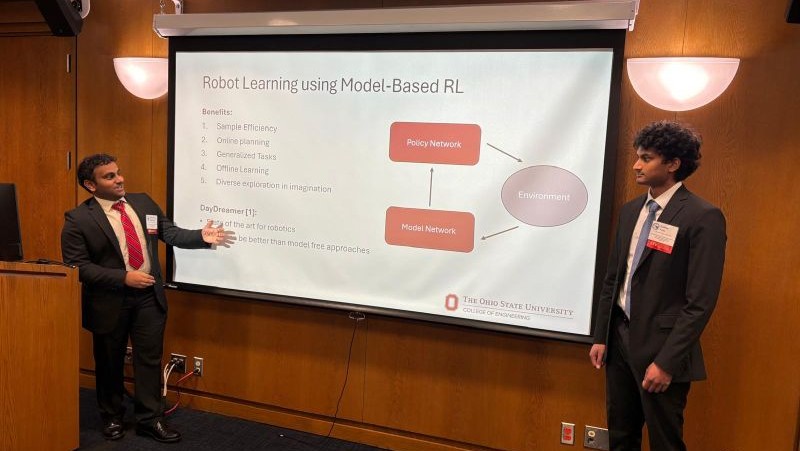
Summary
What it is
An investigation into whether physics-informed structure can help model-based reinforcement learning generalize to quadrotor flight dynamics. The work combines a Dreamer-style world model with known 6-DOF rigid-body physics, then evaluates whether this inductive bias is enough to enable robust policy training for adaptive flight control.
Technical Approach
How it works
The world model predicts net forces and moments acting on the quadrotor as a free body, then integrates them through 6-DOF equations of motion and a Runge-Kutta (RK4) integrator. Both this physics-informed model and an RNN baseline achieved low error on in-distribution rollouts but diverged on out-of-distribution trajectories — pointing to data coverage of transition dynamics as a key bottleneck, not model architecture. Full details in the paper.
Publication
DREAMING Falcon: Physics-Informed Model-Based Reinforcement Learning for Adaptive Quadrotor Control
Eashan Vytla, Bhavanishankar Kalavakolanu, Andrew Perrault, Matthew McCrink — The Ohio State University
AIAA Dayton-Cincinnati Aerospace Sciences Symposium (DCASS) 2025
arXiv:2511.18243